

Evan
July 25, 2026
While it is normal for a swimming pool to lose water, it is not normal for it to lose a lot of water.
That is the kind of conundrum that makes homeowners start pacing in front of their pools. You see the water level drop and decide to top it off so you can get back to your busy week. You return the next week and it has dropped again. The culprit can be the Florida heat, the wind, the children and the afternoon thunderstorms that randomly decide to roll through Jacksonville.
Sometimes you are right. But other times the pool is trying to tell you that there is a leak.
The challenge with leaks is that they do not always present themselves in a dramatic fashion. You will not always see a stream of water running down the deck or ruining the grass. The pool may well look beautiful and the equipment may sound healthy. All that you know is that you continue to add water.
If this sounds familiar it may be time to slow down and start assessing the situation. Is the pool really losing water due to evaporation, splash out, equipment issues, plumbing, a crack or something else? Some water loss is normal and expected in your Jacksonville pool.
Pools lose water naturally. In Jacksonville you can expect the heat, wind, sun, humidity, splash out and water features to play tricks on your water level.
Evaporation tends to be the culprit on warm, dry days. Wind can also increase the rate of evaporation by removing the layer of moisture from the water surface. If your pool has a spillway, waterfall, fountain or other feature, the additional movement of water can contribute to the loss.
Splash out is also a factor, especially if the children are having fun or the pool is being used frequently for parties. It is entirely possible for a pool to lose water without there being a leak. The question is whether the amount of water loss is abnormal.
If it takes a few days to a week to notice a drop in the water level it is likely that the loss is normal for your pool. The concern would be if you have to continually add water or the level is always dropping to the same point.
Before you start digging through the pool deck and worrying about plumbing leaks, ask yourself a simple question.
What has changed?
Was there a change in the weather? Did the pool get more use than usual? Was the waterfall or spa spillway opened? Did a storm occur that pushed water over the edge? Was the filter backwashed? Was a hose left on for a long time and then drained? Did the equipment start making a different noise? Did the water level drop below the skimmer?
Sometimes a small change in the pattern can lead you right to the cause of the leak. For instance, if the water seems to magically disappear only when the pump is running the culprit could be the equipment. If the water is disappearing even when the equipment is off the cause could be the skimmer, light, fittings, drain or somewhere else on the pool shell.
You do not necessarily have to find the leak on your own. Paying attention to patterns will help the pool professional find it faster.
One of the simplest ways to determine whether your pool is losing more water than it should is with a bucket test.
It is not complicated and it can be very effective.
Place a bucket on the second step of your pool and fill it with water until the level is the same as the water level in the pool. You can use a permanent marker to make a reference line on the bucket and on the pool wall so you can easily see the difference. If the amount of water lost by the pool is about the same as the amount lost by the bucket, evaporation is likely to blame. If the pool continues to lose more water than the bucket then you may have a leak.
The EPA WaterSense leak detection resources are a great place for homeowners to start when it comes to water loss and leak detection.
The bucket test will not tell you where the leak is but it will answer the question of whether the water loss is abnormal.
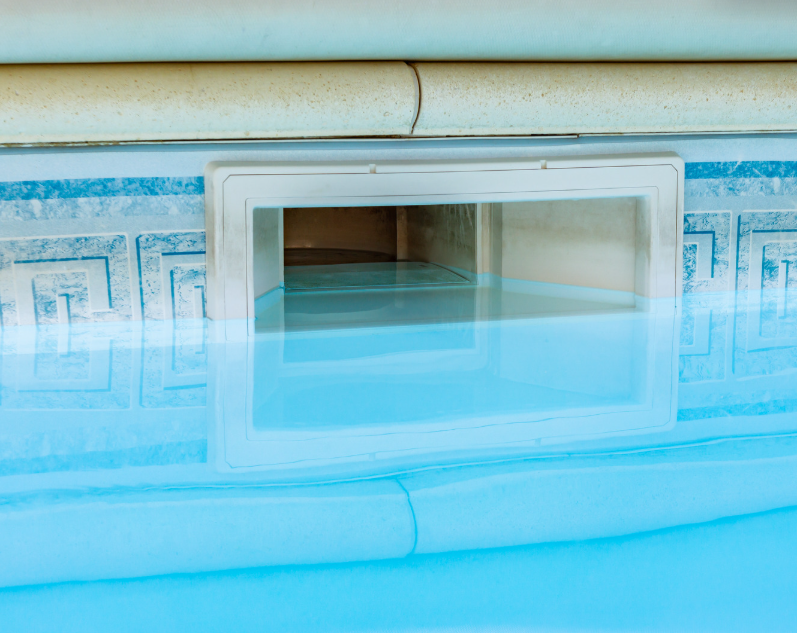
The skimmer is one of the first places to check for leaks.
This is the opening on the pool wall where water flows into the skimmer and then into the filtration system. It is a high traffic area for water and one where cracks or separations can occur.
Look closely at the mouth of the skimmer for cracks, separation, or other issues.
A leak in the skimmer area often does not show itself until the water level drops to the skimmer and then slows down or stops altogether.
That is your queue that the skimmer is the problem.
Do not overlook the skimmer as a source of the leak. It can waste a lot of water and cause additional issues with the pool if it is not repaired.
Cracks around lights, returns, and other fittings can also lead to leaks.
These are areas where something goes through the pool wall so they are sealed. Over time the seal can break down, develop a crack, or become dislodged.
A leak around a light niche can be especially challenging to find since it is below the water level.
The same goes for cracks around a return fitting. If the fitting looks fine but there is a leak around it, it may require a dye test or the help of a pool professional to find it.
If the pool has been resurfaced or repaired, the area around fittings should also be inspected. It is entirely possible for a small opening around a fitting to be the cause of a leak.
All County Pool Services provides pool repair in Jacksonville for cracked tile, equipment, surface issues and other repair needs.
The problem may not be in the pool at all but in the equipment pad.
Look at the equipment, valves, pipes, unions, and backwash line for wet spots, drips, soft ground, or other unusual signs.
Some leaks only show themselves when the pump is running. That means everything may look fine when it is off but it starts dripping as soon as it is turned on.
The drip may seem small and insignificant but it can waste a lot of water over time. It can also put additional strain on the equipment if there is air getting into the system.
If you see wet spots or soft ground around the equipment it is a good idea to have it inspected.
If your pool has a filter system that requires backwashing, the backwash line should also be inspected.
It is possible for the waste line to continue to leak even when the system is not being used. A faulty valve could allow water to escape without anyone realizing it.
The leak could also appear to be coming from the waste line but it may actually be coming from elsewhere on the pool. This is another reason why it is so important to have the leak located by a professional.
If the leak is only apparent when the pump is running, the backwash line should also be inspected. This is a good example of why it can be so expensive to guess at the source of a leak. If you think it is in the shell when it is actually in the equipment or the valves, you will end up spending money unnecessarily.
Not all cracks are created equal.
Some cracks are only on the surface while others go deeper into the pool structure. Some cracks have been there for years while others are brand new. Some cracks continue to grow while others do not change at all.
The most important thing is to have any crack that coincides with a drop in the water level inspected before any cosmetic work is done.
Resurfacing can be a great option for pools with surface cracks but it is always important to rule out other possibilities.
It should never be business as usual when it comes to cracks and leaks. It is one thing to patch small cracks and quite another to hide a serious leak with resurfacing.
If the pool surface is rough, stained, pitted or peeling it may be time to consider a conversation about pool resurfacing in Jacksonville.
One of the most telling signs that a homeowner can look for is the fact that the water level stops dropping at the same place.
If the pool is consistently dropping to the same level it is an indicator that the leak is in that area.
For instance, if the water drops to the very bottom of the skimmer and then stops it is a good indication that the skimmer is the problem. The same goes for the water level stopping at a light or other fitting.
It is not always an indicator but it should be something that the repair professional looks into.
Take a picture of the pool when the water stops dropping. It may also be a good idea to wait before topping it off again if it is safe to do so. This can give the repair professional more information on what to look for.
Of course, it is important not to let the water get so low that it causes issues with the equipment. If the water gets below the skimmer and the equipment is running it is likely pulling in air. It is important to turn it off and get help right away.
It can be challenging to tell the difference between heavy rain and a leak.
The rain can cause the water level to rise while the leak causes it to drop. After a few days of rain it may seem as if the pool has lost water. It may not have lost water at all. It may have gained water but it looks dirty because of the rain. The CDC healthy swimming guidance is a good reminder that clean water is still important even if it looks good.
After days of rain it is always a good idea to start fresh and reset the water level. Observe the pool for a few days and see what happens.
Some pools have an automatic fill system that adds water when the level drops.
While it is convenient, it can also hide a leak.
Instead of realizing that the pool is losing water, the homeowner may notice that the water bill is increasing.
If you think you have a leak but the pool has an automatic fill system it may be necessary to turn it off so the true source of the problem can be found.
Hidden leaks can waste a lot of water when the automatic fill is constantly making up for the loss.
This is another reason why it is important to get in the habit of regularly checking the water level even when everything seems fine.
The most obvious problem with a pool leak is the waste of water but it is not the only issue.
The leak can cause damage to the ground, deck, equipment, and the pool itself. Water that should be in the pool can end up on the ground around it or in the equipment room.
It can also make it more difficult to maintain the pool. The added water from the leak can throw off the water balance which can affect the sanitizer, pH, calcium hardness and other factors.
It can also increase the cost of maintaining the pool if the leak is not repaired in a timely manner.
That is not to say that you should panic every time you notice a drop in the water level. It is more a matter of not being surprised when the small drip leads to a large repair bill after months of neglect.
Sometimes the cause of the drop in the water level is maintenance.
Backwashing, splash out, vacuuming to waste, draining the pool after a storm, or correcting an overfilled pool can all cause the water level to drop. It is entirely possible to have a drop in the water level without there being a leak.
The confusion comes when the drop coincides with maintenance work.
If the pool was serviced and the service involved backwashing, cleaning the filter, or other maintenance it could be the reason for the drop in the water level.
All County Pool Services offers pool maintenance services for Jacksonville homeowners who want to ensure that their pools are clean, balanced, and operating efficiently.
Not all leaks lead to a big remodel but some do.
If the leak is discovered at the same time as other issues it may be the perfect time to consider a remodel in addition to the repair.
Older tile, plaster, coping, equipment, and an outdated layout can all be replaced at the same time the leak is repaired if the situation calls for it.
All County Pool Services provides pool remodeling in Jacksonville for homeowners who want to go beyond the repair and update their pools.
The right solution will vary depending on the situation.
Sometimes it is best to do a simple repair while other times it makes more sense to do a complete project.
If you added water to the pool after a hot weekend, it is probably not a problem. If you continue to add water and it seems to disappear it is time to call for help.
Call a pool professional if you see signs of water loss along with any of these issues.
The professional can inspect the pool to determine whether the cause is the shell, plumbing, equipment, fittings, skimmer, lights or something else.
Pool leaks can be simple or complex which is why it is important to work with someone who knows how to repair, replace, resurface and remodel rather than just one area.
Before hiring anyone, Florida homeowners should always use the Florida DBPR license search to verify that the contractor is properly licensed.
That way there will not be any surprises when it comes to the work and the cost.
A good contractor will not make assumptions about the cause of the leak. He or she will inspect the pool to determine the real cause. If the water is only disappearing when the pump is running the cause is likely to be in the system. If the water is disappearing to the same place it could be a fitting. If the surface of the pool is cracked it may need to be repaired or replaced.
The goal should be to find the problem and not to sell an unnecessary project.
It depends on the pool but some evaporation is normal especially on hot, dry days. Wind can also play a role in how much water is lost. If you are constantly having to add water it is a good indication that something is wrong.
Yes. Some leaks are only apparent when the pump is running which means that they are related to the system.
Yes. Some leaks are apparent when the pump is off which means that they are related to the shell, skimmer, light, fittings or other features on the pool.
No. The bucket test is a good start but it only shows whether the leak is greater than the amount of water lost to evaporation.
It depends on the cause of the leak. If the leak is related to the surface of the pool and it is repaired during resurfacing it can be effective. If the leak is related to the plumbing, skimmer, fittings or lights it will not be fixed by resurfacing.
Keep enough water in the pool to protect the equipment. At the same time, do not keep filling the pool for weeks on end without determining the real cause of the problem.